Claude 4 Changed Everything About How Agents Work. Most Teams Have Not Adjusted.
Every major model release is described as a breakthrough.
Most of them are incremental. Better benchmarks. Slightly improved reasoning. Marginally lower cost. The gap between the old model and the new one is real but not structurally significant. Teams update their model string, run their evals, confirm performance is similar or better, and move on.
Claude 4 was not that kind of release.
The architectural changes Anthropic made between the Claude 3 family and the Claude 4 family changed something fundamental about how the models behave as agents. The instruction following is more literal. The context handling is different. The way the model interprets ambiguous prompts has shifted in ways that are subtle enough to miss in evaluation and significant enough to cause real problems in production.
The teams that noticed are quietly ahead. The teams that did not are quietly struggling.
What actually changed
The most significant behavioral change in Claude 4 is not in raw capability. It is in how the model handles underspecified instructions.
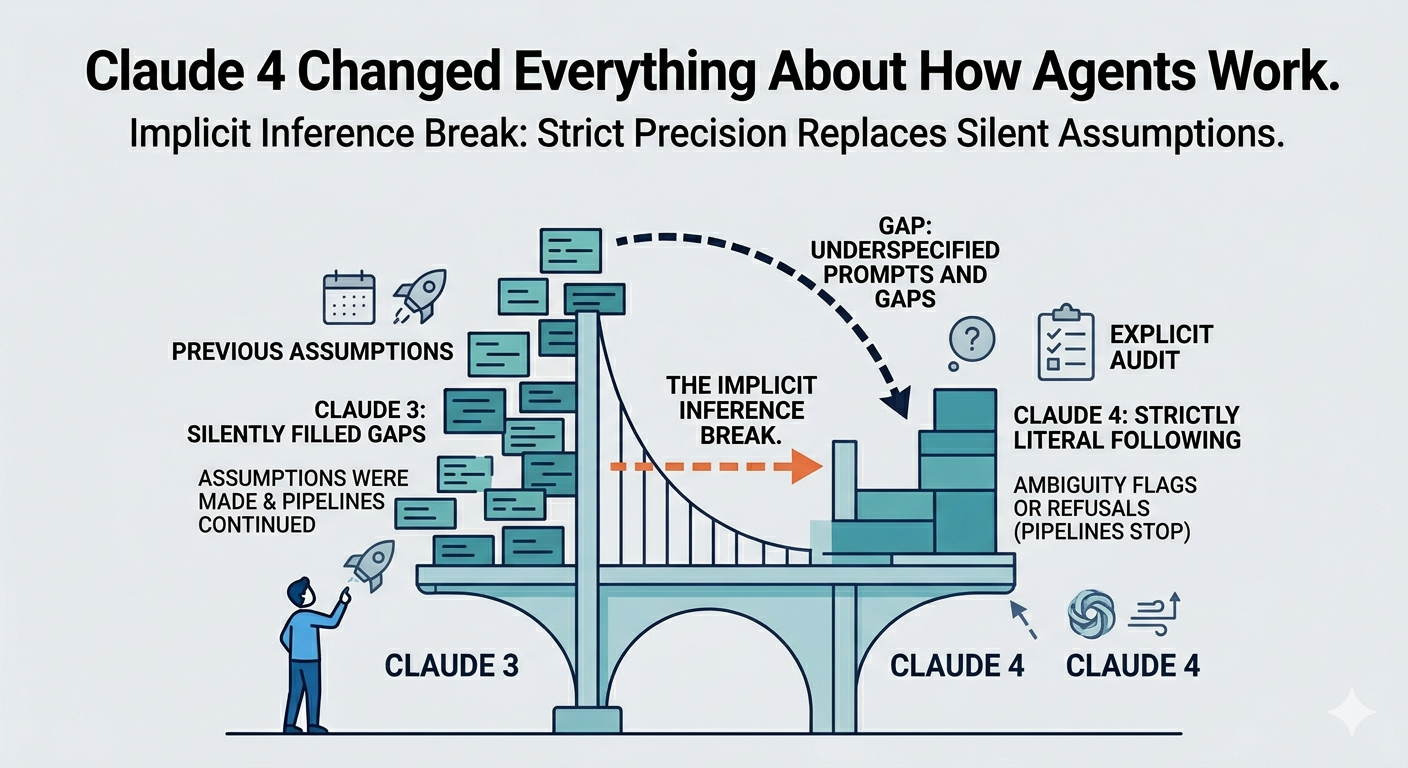
Claude 3 models were, in hindsight, quite forgiving. When a prompt was ambiguous, the model made a reasonable assumption and proceeded. It filled gaps. It inferred intent. It did what it seemed like you probably meant rather than what you literally said.
This felt like good behavior. In demos it was good behavior.
In production agent systems it was a source of subtle, hard-to-reproduce failures. The model was making assumptions you did not know it was making. When those assumptions were wrong, the failure was difficult to diagnose because the prompt looked correct. The model was not following the prompt correctly, because it was following what it inferred the prompt to mean, and the inference was sometimes wrong.
Claude 4 does less of this.
When an instruction is ambiguous, the model is more likely to ask for clarification or flag the ambiguity rather than resolve it silently. When context is insufficient, the model is more likely to say so rather than proceed with a confident guess.
For interactive use cases, this is strictly better behavior. Users get clearer feedback. The model is more honest about what it does not know.
For automated pipelines where nobody is watching, this is a breaking change.
The pipelines that relied on the model resolving ambiguity silently are now getting clarification requests or refusals where they used to get completions. The agents that were built assuming the model would fill gaps are now failing at the gaps.
The prompts that broke
The pattern that broke most consistently across teams upgrading from Claude 3 to Claude 4 is the underspecified system prompt.
Teams running agents for months develop a particular relationship with their prompts. They know what works. They have tuned the language over dozens of iterations. The prompt has accumulated specific phrases because specific phrases produced better behavior.
What they often do not know is which parts of the prompt are doing real work and which parts are load-bearing in ways they never explicitly intended.
Claude 3 tolerated a lot of implicit load-bearing. The model would read a prompt that said “help users with their questions about our product” and infer that this meant answering in the company’s tone, staying within certain topic boundaries, escalating when appropriate, and dozens of other behaviors that were never specified.
Claude 4 reads that prompt more literally. It helps users with their questions. The tone, the boundaries, the escalation logic: if those are not specified, they are not inferred.
The teams whose prompts were built on implicit inference are now discovering which behaviors they never actually specified.
The agent architecture that stopped working
Beyond prompts, the agent architectures that worked well with Claude 3 are failing in specific ways with Claude 4.
The most common failure is in multi-step agents where intermediate steps can produce ambiguous outputs that feed into subsequent steps.
With Claude 3, the model at the subsequent step would interpret the ambiguous output charitably and proceed. The chain continued. The task completed.
With Claude 4, the model at the subsequent step is more likely to flag the ambiguity and stop. The chain breaks. The task fails.
From a correctness standpoint, Claude 4 is behaving better. The Claude 3 agent was making assumptions that might have been wrong. The Claude 4 agent is refusing to make assumptions that might be wrong.
From an engineering standpoint, the teams that built pipelines around Claude 3’s assumption-making are now looking at failure rates they did not have before.
The fix is not to make Claude 4 behave more like Claude 3. The fix is to make the intermediate outputs more explicit so the model does not need to make assumptions. This is better engineering. It requires engineering effort that teams are being forced to make under production pressure rather than proactively during development.
What the teams ahead of this did
The teams that navigated this transition well shared one practice.
They ran their entire agent pipeline against the new model in staging before promoting it, with a systematic review of every place in the pipeline where ambiguity existed.
Not a vibe check. A structured audit.
They walked through every step in the agent flow and asked: what would this model do if the input to this step was malformed, incomplete, or ambiguous? They were looking for places where the previous model’s forgiveness was doing real work.
Every place they found became an explicit specification rather than an implicit assumption. The prompt was updated to state what the behavior should be. The output format of the preceding step was tightened so ambiguity could not occur.
The resulting pipeline was more brittle in the sense that it relied less on model forgiveness. It was less brittle in the sense that when something went wrong, it went wrong explicitly rather than silently.
That is the right trade.
The evaluation that did not catch it
The teams that were caught off guard have a common factor too.
Their evaluations tested outcomes, not behaviors.
They ran the new model against their eval suite. The eval suite checks whether the final output of the agent is correct. The final output was often still correct because many tasks can be completed correctly via multiple paths, including paths that involve the model making assumptions.
What the evals did not test was the intermediate behavior. Whether the model was proceeding confidently or hedging internally. Whether the chain was completing because the steps were explicit or because the model was being forgiving about gaps.
The evals passed. The team promoted. Production showed different behavior.
This is the evaluation trap for complex agent systems. Output correctness is necessary but insufficient. Behavioral correctness at every intermediate step is what determines whether the system is robust or fragile.
Building evals for intermediate behavior is harder than building evals for final outputs. It is also the difference between catching this class of failure before promotion and discovering it after.
What to check in your own stack right now
If you are running Claude models in any agent or pipeline, three specific things are worth auditing immediately.
Anywhere your prompt relies on the model inferring behavior that is not stated. Anywhere your pipeline passes intermediate outputs from one step to the next without explicit format validation. Anywhere you have observed increased clarification requests or refusals since a recent model update.
These are not edge cases. They are the specific places where the behavior change between Claude 3 and Claude 4 will have landed in your system.
Finding them now is faster than debugging them from production incidents later.
The model changed.
Most systems that depend on it have not fully caught up.
That gap is where the next wave of quiet production failures will come from.
It is also, for the teams that close it proactively, where the next wave of quiet competitive advantage will come from.