MCP Is the Most Important Thing Happening in AI Right Now. Nobody Is Talking About the Risk.
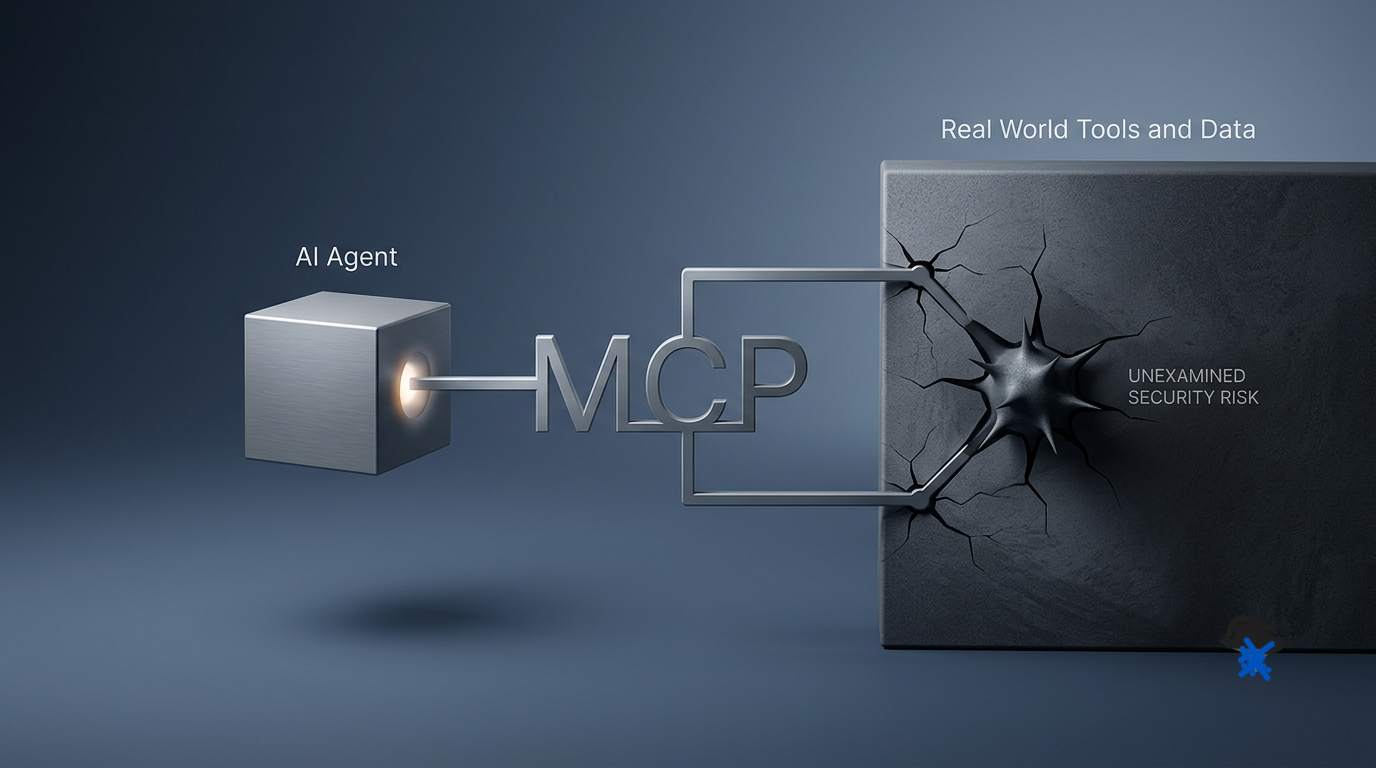
Six months ago, MCP was a niche protocol that a small number of developers were experimenting with.
Today it is the connective tissue of the AI agent ecosystem.
Claude uses it. Cursor uses it. Hundreds of tools have published MCP servers. Every major agent framework has built-in MCP support. The companies that moved fast on MCP integration are now the default choice for teams building agent infrastructure.
The adoption curve is one of the fastest in recent developer tooling history.
And the conversation about what this means for security is almost entirely absent.
What MCP actually is
Model Context Protocol is a standard way for AI models to connect to external tools and data sources.
Before MCP, every AI integration was custom. You wanted your agent to read from a database, you built a custom tool. You wanted it to call an API, you wrote a custom wrapper. The integrations were one-off, non-transferable, and fragile.
MCP standardises this. A tool that exposes an MCP server can be connected to any agent that supports MCP without custom integration work. The protocol handles the communication. The agent gets access to the tool’s capabilities through a consistent interface.
This is genuinely useful. The ecosystem benefits of a standard protocol are real. Teams that previously spent weeks building custom integrations can now connect to an MCP server in hours.
The speed is the point. The speed is also the problem.
The permission model that nobody examined
Every MCP server exposes a set of capabilities to the agent that connects to it.
Those capabilities can include reading files, writing files, querying databases, calling APIs, executing code, managing cloud resources, sending messages, and dozens of other actions with real-world consequences.
When an agent connects to an MCP server, it gains access to everything that server exposes. Not a subset. Everything.
The assumption baked into most MCP server implementations is that if the agent is allowed to connect to the server, it is allowed to use all of the server’s capabilities.
This assumption is wrong in the same way that giving a new employee full admin access to every system on their first day is wrong. The access may be granted in good faith. The surface area for things to go wrong is enormous.
The MCP ecosystem has reproduced, at protocol scale, the same excessive-access problem that individual agent deployments have been accumulating for months.
Except now it is standardised.
The third-party server problem
When a team builds their own MCP server, they control what it exposes. The risks are the risks of their own implementation.
The ecosystem also includes third-party MCP servers. Servers built by vendors, by open source contributors, by companies trying to increase their tool’s adoption. These servers are installed alongside agent infrastructure and granted access to local systems and data.
Installing a third-party MCP server is, in the current ecosystem, roughly equivalent to installing a browser extension from an unknown developer and granting it access to everything on your machine.
Most developers who install browser extensions do not read the permission requests. Most developers installing MCP servers are not auditing the code for what it actually does with the access it is granted.
The gap between the trust implied by ease of installation and the access actually granted is significant.
And the MCP ecosystem is moving so fast that the community norms around auditing and trust that eventually developed in other ecosystems have not had time to form.
The prompt injection surface just got dramatically larger
Every MCP tool that reads external content is a prompt injection surface.
An MCP server that reads emails. An MCP server that fetches web pages. An MCP server that reads documents from a shared drive. Each of these creates a path by which external content can influence the agent’s behavior.
This was already a problem for individual agent deployments. MCP makes it a protocol-level problem.
When every agent in the ecosystem connects to the same category of tools through the same protocol, a successful prompt injection technique that works against one MCP-connected agent will likely work against many others. The attack surface is not a single deployment. It is the entire class of agents using that protocol.
Security researchers have already demonstrated several classes of MCP-specific attacks. Malicious MCP servers that misrepresent their capabilities to gain additional permissions. Tool description poisoning that influences agent behavior through the metadata the agent reads to understand what a tool does. Cross-server attacks where one MCP server influences the agent’s interactions with another.
These are not theoretical edge cases. They are documented attack patterns against a protocol that is being deployed in production right now.
What the fast-moving ecosystem is skipping
The developer tooling ecosystem has a pattern when a genuinely useful abstraction arrives.
First comes excitement. Adoption is fast. Integration is easy. Everyone is building on it. Conference talks celebrate the speed of what is now possible.
Then come the incidents. The abuse cases. The things that were obvious in retrospect but were not obvious in the excitement phase. Security researchers start writing papers. Post-mortems start getting published. The community starts developing norms that should have existed from the start.
MCP is in the excitement phase right now.
The incident phase is coming. The question is whether it arrives as a learning experience for the ecosystem or as a damaging breach that triggers a regulatory response and a loss of trust in AI agent tooling broadly.
The excitement is warranted. The protocol solves a real problem. The speed of adoption is a testament to how badly the problem needed solving.
The security foundations being laid right now, or not being laid right now, will determine which version of the incident phase arrives.
The questions every team should be asking
If you are using MCP in any production system, three questions determine your current risk exposure.
What does each MCP server you have installed actually have access to? Not what it claims to have access to. What permissions it has been granted, what data it can read, what actions it can take. If you cannot answer this for every server in your stack, you have unexamined access in your infrastructure.
What happens if a third-party MCP server you have installed behaves maliciously or is compromised? Does it have access to credentials? To source code? To production databases? To external APIs that can take actions in the real world? The blast radius of a compromised MCP server should be bounded and known.
What content can reach your agent through MCP-connected tools, and could that content influence the agent to take actions you did not intend? Every tool that reads external content is a potential injection vector. The list of those tools in your stack is your prompt injection surface.
These are not hypothetical security concerns for a future version of your system.
They are present risks in the system you are running today.
The ecosystem that gets this right wins
MCP is not going away. The benefits are real and the adoption is too far along to reverse.
The question is not whether to use it. The question is whether the ecosystem develops the security culture it needs before the incidents that will force that development.
The projects that are leading on this are the ones building explicit permission models into their MCP implementations. Servers that expose only what a specific task needs. Audit logging at the protocol level that makes every action traceable. Sandboxing that limits what a server can access regardless of what it requests.
This work is slower than just shipping MCP integration and moving on.
It is also the difference between MCP being remembered as the protocol that made AI agents trustworthy at scale and MCP being remembered as the protocol that made it easy to give AI agents too much access to too many things at once.
The tools that get the security model right in the next six months will become the default choice for production deployments.
The tools that do not will become the cautionary tales that security teams use to justify why AI agents are not allowed near anything important.
The window is open right now.
It will not be open much longer.