Reasoning Models Are Making Your Product Slower and Your Bills Larger. Teams Keep Using Them Anyway.
 Something changed in how AI labs market their models over the past year.
The race used to be about speed. Faster inference. Lower latency. Snappier responses. The benchmark that mattered was how quickly you could get an answer.
Now the race is about the opposite.
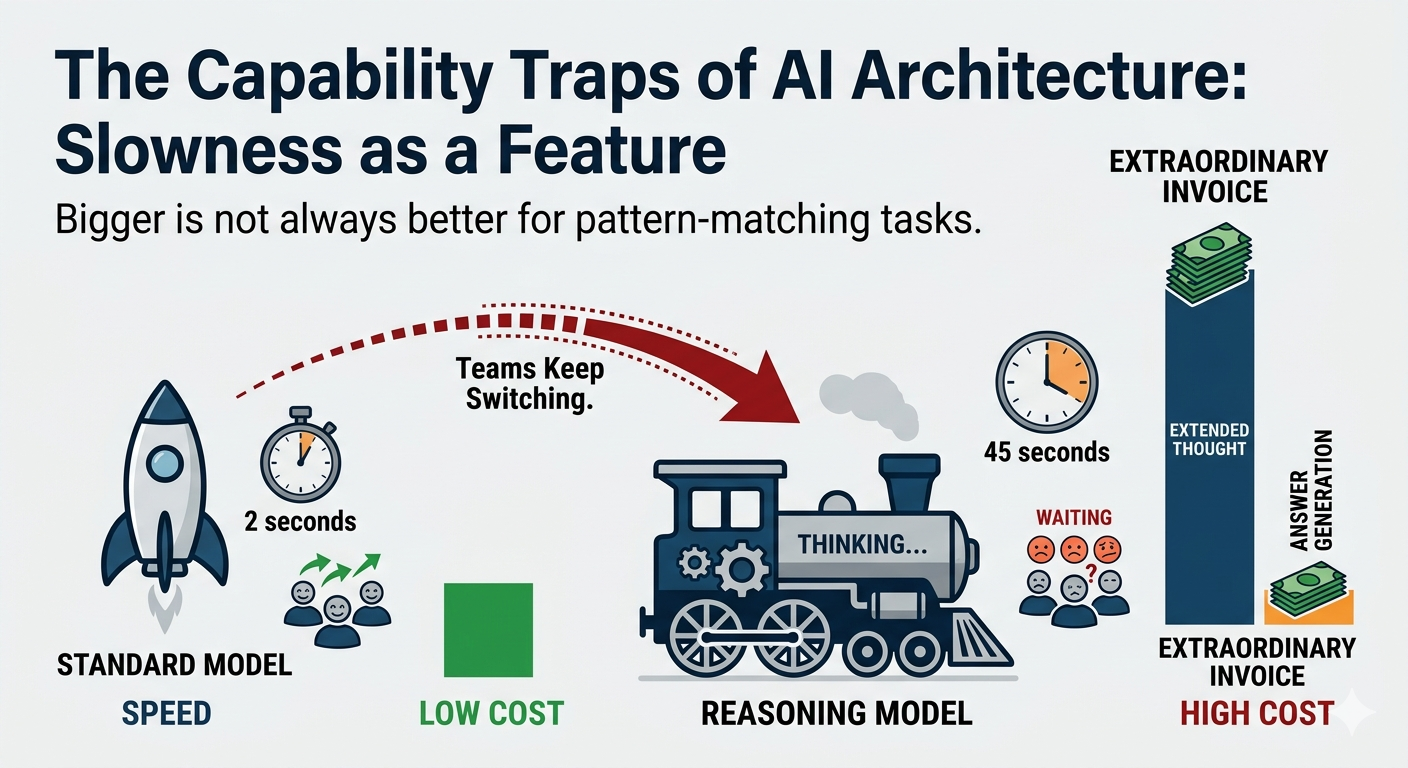
Extended thinking. Deep reasoning. Models that pause before they respond. Models that show their work. Models that take thirty seconds where a standard model would take two.
The labs are selling slowness as a feature. And it is a feature, for a specific set of problems.
The problem is that most teams are not using reasoning models on that specific set of problems.
They are using them on everything. Because the reasoning model is the newest, most impressive thing available, and in tech, newest and most impressive tends to win the internal argument regardless of whether it is appropriate.
What reasoning models actually do
When a reasoning model takes thirty seconds to respond, it is not stalling.
It is running an internal dialogue. Considering approaches. Catching its own errors. Exploring alternatives. Arriving at an answer that is meaningfully better than what a standard model would produce on genuinely complex tasks.
On hard mathematical problems, reasoning models are dramatically more accurate. On multi-step logic puzzles, they are dramatically more reliable. On complex code debugging where the failure is subtle and the search space is large, the extended thinking produces answers that standard models consistently miss.
This is real. The capability improvement on the right tasks is not marginal. It is the difference between a model that cannot solve the problem and a model that can.
The key phrase is the right tasks.
The tasks that do not need thirty seconds of thought
Here is a partial list of things your AI-powered product is probably doing right now that do not require extended reasoning.
Classifying customer support tickets into categories. Summarising a document that is already well-structured. Extracting specific fields from a form submission. Generating a product description from a list of attributes. Translating text from one language to another. Deciding whether a piece of content violates a policy. Answering a factual question with a retrievable answer. Routing a request to the correct downstream handler.
Every one of these tasks is pattern matching. The answer is not arrived at through reasoning. It is recognised through pattern recognition. Standard models do pattern recognition extremely well. Reasoning models do it just as well but take fifteen times longer and cost significantly more.
When you run a reasoning model on a classification task, you are paying for thirty seconds of thinking about a problem that does not require thinking. The model does not produce a better classification. It produces the same classification, more slowly, for more money, because it spent time considering approaches to a problem that only has one obvious approach.
The latency that killed the product
User experience research on acceptable latency is not ambiguous.
For interactive products, users notice delays above 200 milliseconds. Above one second, users start to disengage. Above three seconds, a meaningful percentage abandon the interaction entirely.
Reasoning models, on complex tasks, take between fifteen and sixty seconds to respond.
This is not a number that works in an interactive product. It is a number that works in a batch processing pipeline where the user is not waiting for a real-time response.
The teams that discovered this the hard way are the ones that built a conversational product on a reasoning model, shipped it, watched the engagement metrics, and found that users were dropping off at a rate that did not make sense given how good the responses were.
The responses were good. The users were not waiting for them.
A mediocre response in two seconds outperforms an excellent response in forty-five seconds in almost every interactive context. This is not a controversial finding. It is basic product psychology that the capability excitement overrode during the build phase.
The bill that arrives in month two
The cost difference between a reasoning model and a standard model is not subtle.
It is roughly ten to twenty times the price per token, combined with significantly more tokens generated during the thinking phase.
For a product running at any real scale, this difference is not a line item. It is a strategic problem.
A feature that costs eight thousand dollars a month on a standard model costs between eighty and one hundred and sixty thousand dollars a month on a reasoning model.
Teams that built features in the excitement of a new capability without running this calculation are finding it in month two. The feature works beautifully. The cost of running it is not compatible with the business model at current pricing.
Rebuilding a feature to run on a cheaper model after it has been shipped to users is expensive. The prompting is different. The output quality characteristics are different. The edge cases the reasoning model handled elegantly that the standard model does not handle are now engineering problems.
The rebuild takes longer than the original build. It happens under budget pressure. The output is usually worse than if the team had made the right model choice at the start.
Where reasoning models are actually worth it
The tasks that genuinely benefit from extended thinking share a common structure.
The problem space is large and non-obvious. The solution requires exploring multiple approaches before finding one that works. A wrong intermediate step does not just produce a wrong answer at the end but poisons the reasoning that follows it. The correctness of the answer is more important than the speed of the answer.
Complex debugging where the failure has multiple potential causes. Mathematical or logical proofs. Code architecture decisions where the trade-offs are genuinely multi-dimensional. Security vulnerability analysis. Long-document synthesis where contradictions need to be identified and resolved.
These are real tasks. Engineering teams have them. Paying for thirty seconds of thinking on these tasks is worth it.
The proportion of AI workload in most products that falls into this category is somewhere between five and twenty percent.
The proportion of AI workload running on reasoning models in most products is considerably higher than that.
The decision most teams never made
Nobody at most companies sat down and decided that the routing classifier should run on the same model as the complex code analysis.
It happened incrementally. The team chose a reasoning model for the flagship feature where it genuinely helped. The next feature was built by a different engineer who used the same model because it was already in the codebase. The feature after that did the same. The reasoning model became the default through inertia rather than decision.
This is how most AI infrastructure debt accumulates. Not through bad decisions. Through the absence of decisions. Nobody chose to run classification tasks on reasoning models. Nobody chose not to either.
The teams that are managing this well made an explicit choice and documented it. Reasoning models for tasks above a complexity threshold. Standard models for everything else. The threshold is defined, enforced, and revisited quarterly as model capabilities and pricing change.
Everything below the threshold runs on Haiku or Sonnet. Everything above it runs on the reasoning tier.
The boundary is imperfect. It is dramatically better than no boundary.
The next announcement will make this worse
Every major lab has reasoning model improvements on the roadmap.
The capabilities will improve. The prices will likely drop, but not to parity with standard models. The marketing will be compelling. The demos will show the cases where reasoning produces extraordinary results.
Every new announcement will generate internal pressure to upgrade. To use the new capability. To run on the latest and most powerful thing available.
The teams without a framework for making this decision will respond to each announcement by expanding their reasoning model usage. Each expansion will feel justified in isolation. The aggregate will be a cost structure and a latency profile that the product cannot sustain.
The teams with a framework will evaluate the announcement against the threshold. They will upgrade the tasks that benefit. They will leave the tasks that do not benefit exactly where they are. Their costs will be predictable. Their latency will be appropriate. Their product decisions will be deliberate rather than reactive.
The capability gap between reasoning models and standard models will continue to grow on the tasks where reasoning matters.
The cost gap will continue to grow alongside it.
The teams that know which tasks are which will capture the capability improvement without paying the cost everywhere.
The teams that do not know will pay the cost everywhere and wonder why the economics of AI features never quite work out.
The reasoning model is a remarkable tool.
It is a tool with a specific job.
Using it for every job is how remarkable tools become expensive problems.