The LLM Knows Everything. It Understands Nothing About Your Business.
The demo always works.
You open a chat interface to the latest frontier model. You ask it a hard question about software architecture, or marketing strategy, or competitive positioning. The answer is thoughtful, well-structured, and demonstrates a command of the subject that would impress most senior practitioners.
The model is genuinely impressive. The knowledge is real.
Then you try to use it for your actual business.
You ask it about your specific customer segment. It gives you a generic answer about that type of customer. You ask it about your pricing model. It reasons from general principles. You ask it how to handle the edge case that comes up every third Tuesday with the accounts in your enterprise tier. It has no idea.
The model knows everything about the world in general. It knows nothing about your world specifically.
And that gap is where most enterprise AI projects are failing right now, quietly, expensively, in ways that are easy to blame on the technology rather than on the misunderstanding of what the technology actually provides.
What the model was trained on
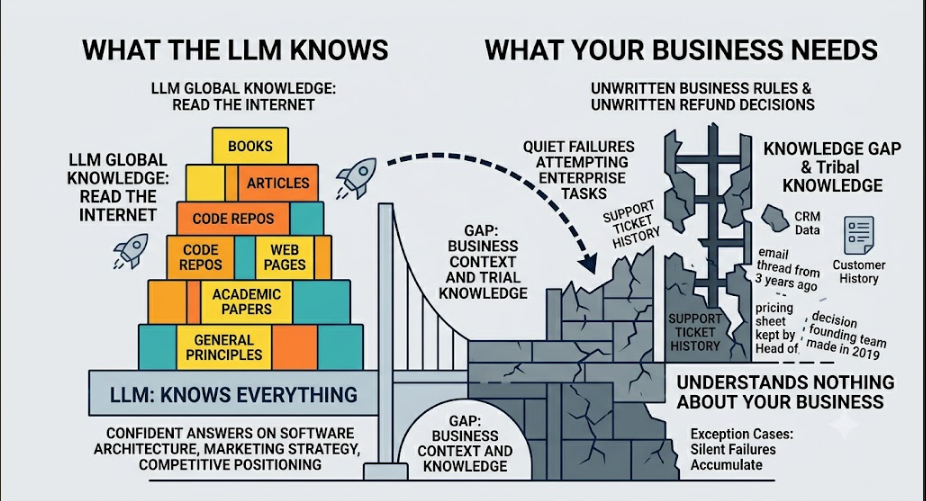
Every frontier model was trained on a vast corpus of human-generated text. Books. Articles. Code repositories. Forum discussions. Academic papers. Web pages. The cumulative output of human knowledge up to a cutoff date.
This training produces something remarkable. A system that can reason across domains, synthesise information, explain complex concepts, and generate useful outputs across an enormous range of tasks.
It does not produce a system that knows your business.
Your business knowledge does not live on the internet.
It lives in your CRM. In your support ticket history. In the email thread from three years ago where the founding team made a decision that still governs how you handle refunds. In the spreadsheet your head of sales maintains with the real discount structure that differs from the official pricing page. In the tribal knowledge of the five people who have been there from the beginning.
None of that was in the training data.
The model has never seen it.
When you ask the model to help with something that requires it, the model will produce a plausible answer based on what similar businesses in similar situations have done. That answer may be directionally useful. It will not be specifically correct.
The confident answer that was wrong for you
Here is the failure mode that is costing the most money right now.
A team deploys an AI system to handle a business process. Customer support. Sales qualification. Contract review. Internal knowledge management.
The system works well on the general cases. It handles the questions that have known answers. It produces outputs that look correct to someone who does not know the business deeply.
It fails on the specific cases. The exceptions. The business rules that are not written down anywhere but that every experienced employee knows. The customer relationships that have history. The product limitations that are not in the documentation because they were discovered in production and the fix is a workaround that nobody remembered to document.
The model does not know about any of this.
So it produces confident, plausible, wrong answers.
The wrongness is not obvious at the output level. The answer looks reasonable. Someone has to know the specific business context to identify that it is wrong. And the whole reason the AI system was deployed was to reduce the need for people with that specific business context.
The failure is silent. It accumulates. Eventually a customer is given incorrect information, or a contract is reviewed incorrectly, or a sales qualification decision is made on the wrong basis.
By that point the errors are downstream consequences of an architectural assumption that was never examined.
The retrieval approach that partially works
The standard answer to this problem is retrieval-augmented generation.
Index your internal documentation. When a question comes in, retrieve the relevant documents. Include them in the context. The model now has your business knowledge.
This is better than nothing. It is not sufficient.
The problem is that most business knowledge is not in your documentation.
You cannot retrieve what has not been written down. You cannot index tribal knowledge. You cannot embed the judgment that comes from three years of watching a specific customer segment behave in ways that defied the initial model.
RAG solves the documented knowledge problem. Most businesses have a much larger undocumented knowledge problem.
The teams that discover this deploy RAG. The simple cases improve. The complex cases, the ones that actually required business context, do not. The team upgrades the retrieval. Adds more documents. Improves the chunking strategy. The simple cases improve further. The complex cases do not.
At some point someone asks the question that should have been asked at the beginning.
What percentage of the knowledge needed to handle these cases is actually written down anywhere?
For most businesses the honest answer is between twenty and forty percent.
The rest lives in people.
What it actually takes
The businesses getting the most value from AI are not the ones with the best RAG implementations.
They are the ones that treated the AI project as an occasion to externalise the knowledge that was living in people’s heads.
Not because the AI required it. Because the AI project finally created the pressure to do something that was always valuable and never prioritised.
The customer success team that had never written down their escalation logic was asked to write it down so the AI could use it. The result was an escalation playbook that new hires now use to onboard in two weeks instead of six. The AI was the excuse. The playbook was the value.
The sales team that had never documented the real objection handling process, just the official one, was asked to record and transcribe their actual calls. The transcripts revealed patterns that had never been visible. The AI system trained on those patterns is more effective than the one trained on the official playbook. But the real value was the pattern recognition the team gained in the process.
The support team that had never mapped the actual decision tree for complex cases, just the first-level triage, spent two months building a true decision tree before deploying the AI. The decision tree is now the most valuable internal document they have. The AI is the implementation of the tree. The tree is the product.
In every case, the AI was the catalyst.
The knowledge externalisation was the transformation.
The question your AI project cannot answer yet
Every AI project in your organisation is implicitly betting that the knowledge needed to do the task well is accessible to the model.
Some of that bet is against public knowledge. The model has it. Some of it is against documented internal knowledge. RAG can surface it.
The rest of the bet is against undocumented institutional knowledge. And that part of the bet is losing quietly in every organisation that has not explicitly addressed it.
Before the next AI project starts, one question is worth answering honestly.
Of all the knowledge an expert human would use to handle this task well, how much of it is written down in a form the model could access?
If the answer is most of it, the project has a good foundation.
If the answer is some of it, the project needs a knowledge capture phase before the AI build.
If the answer is not much of it, the project’s first phase is not building the AI. It is building the knowledge base that the AI will eventually use.
That phase is slower than building the model integration. It is also the phase that determines whether the model integration produces something useful or produces something that works in the demo and fails in production.
The advantage hiding in the gap
Here is the counterintuitive part.
The gap between what models know and what your business needs is not just a problem. It is a moat.
Every competitor can access the same frontier models. Every competitor can implement the same RAG architecture. The public knowledge that the model was trained on is available to everyone.
The specific knowledge of your business, your customers, your hard-won expertise, that is available only to you. If you externalise it in a form the model can use, you create something your competitors cannot replicate just by upgrading their model.
The teams that understand this are investing in knowledge infrastructure alongside model infrastructure.
They are treating the documentation of business knowledge as a strategic asset with the same seriousness as their proprietary data. Because it is one.
The model knows everything about the general case.
The team that gives it everything about their specific case is the team that is building something genuinely hard to replicate.
The gap is the moat.
Fill it deliberately.
The model will do the rest.