The AI Bubble Isn't Popping. It's Bifurcating.
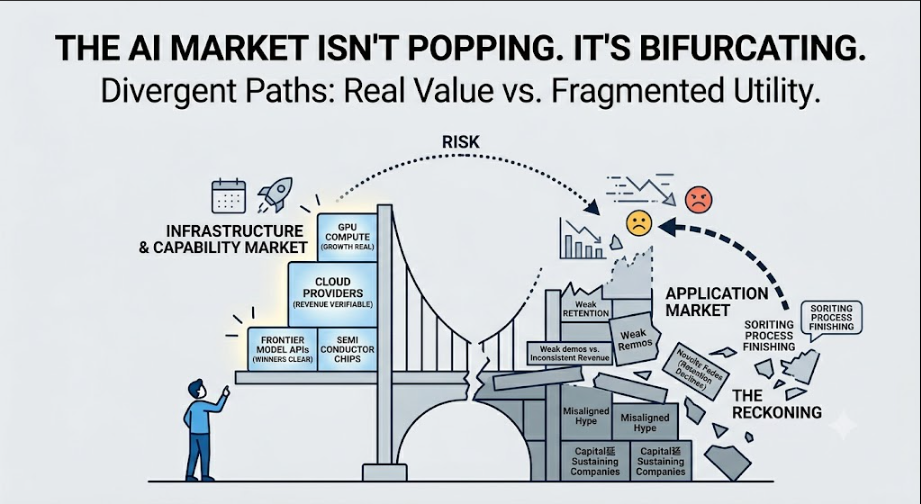
Every few weeks, a new piece goes viral arguing one of two things.
Either AI is transforming everything and the skeptics are missing the most important technology shift in a generation and will look foolish in retrospect.
Or AI is a massive bubble, the use cases are overhyped, the revenue does not justify the valuations, and the reckoning is coming.
Both camps have data. Both camps have credible voices. Both camps are looking at different parts of the same elephant and describing it as if they have seen the whole animal.
What is actually happening is more complicated than either narrative. The AI market is not inflating uniformly and it is not deflating uniformly. It is splitting into two separate markets that follow completely different dynamics.
Understanding the split is the most useful thing you can do right now if you are building, investing, or making strategic decisions about AI.
The two markets
The first market is infrastructure and capability.
This is where the money is enormous, the growth is real, the revenue is verifiable, and the winners are becoming clear.
Cloud providers selling GPU compute. The frontier model labs selling API access. The semiconductor companies making the chips that run everything. The tooling companies that sit close enough to infrastructure that their revenue is directly tied to model usage volume.
In this market, the hype and the reality are roughly aligned. The demand for compute is genuinely extraordinary and genuinely growing. The revenue is real and auditable. The companies with real infrastructure advantages are growing faster than their valuations suggest.
The second market is application.
This is where the money is also enormous, the growth is mixed, the revenue is inconsistent, and the winners are far from clear.
Products built on top of the infrastructure. Software that uses models to automate tasks, generate content, or provide intelligence to end users. The thousands of companies that raised capital on the premise that AI would transform their specific category.
In this market, the hype and the reality are dramatically misaligned. Many companies have impressive demos and weak retention. The use cases that work are working well. The use cases that do not work are taking longer to fail than they should because the capital environment kept them alive past their natural end.
Why the bubble argument misses
The people arguing bubble are looking at the application market and correctly identifying that most of the value has not materialised.
Most AI applications are not delivering the promised transformation. User retention is weak. Revenue per user is declining as novelty fades. The category leaders are not as dominant as expected. The enterprise deals are smaller than the hype suggested.
All of this is true.
The bubble argument then extends this observation to the entire AI industry and concludes that the whole thing is overhyped.
This conclusion does not follow.
The infrastructure market is not in a bubble by any reasonable definition. The demand for compute is real. The companies providing it have revenue that matches their growth. The valuations are high but so is the trajectory.
Saying AI is in a bubble because AI applications are struggling is like saying the internet was a bubble in 2002 because most dot-coms failed. The infrastructure layer of the internet was not a bubble. It was the foundation that the next twenty years of value would be built on. The application layer was overextended.
Same dynamic. Different technology. Same analytical error.
Why the bull argument also misses
The people arguing that AI is transforming everything are looking at the infrastructure market and correctly identifying that the growth is real, the revenue is real, and the winners are becoming very large.
They are also looking at the best application examples. The cases where AI has genuinely transformed a workflow. The products that have found genuine product-market fit. The companies growing fast with strong retention.
These cases exist. They are real.
The bull argument then generalises from these examples to the entire application market and concludes that the transformation is universal and the skeptics are missing it.
This conclusion also does not follow.
The application market is bifurcated within itself. There is a small number of AI applications that are genuinely working. Strong retention. Real workflow transformation. Revenue that is growing without inflection toward a plateau. Users who have changed how they work in durable ways.
And there is a much larger number of AI applications that are not working. High initial adoption driven by curiosity. Declining retention as the novelty fades and the limitations become apparent. Revenue that is not growing organically. Users who tried it and continued using their previous workflow.
Averaging these two groups produces a picture that looks like moderate success. Looking at them separately reveals a market that is working very well in some places and not working at all in many others.
The applications that are actually working
The AI applications with genuine product-market fit share a specific characteristic.
They are not doing something the user used to do manually and now does with AI assistance. They are enabling something the user could not do at all before.
Not faster writing. Writing at a scale that was previously impossible. Not better data analysis. Analysis of data sources that previously could not be connected. Not improved customer service. Customer service at a response depth that a human agent at that cost could not provide.
The applications that are working have found a task where the human alternative was not just slower but genuinely infeasible. The AI is not a better tool for the existing workflow. It is the only practical tool for a new workflow.
This category is smaller than the AI hype suggests. It is also much larger than the AI skeptics acknowledge. The tasks that only AI can do practically are multiplying as the models improve and as teams learn to deploy them.
The companies that found these tasks early are the ones with the retention curves that look different from the rest of the market.
The capital that changes the dynamics
There is a reason the application market bifurcation has not been more visible.
The capital environment has been sustaining companies that should have found their answers by now.
A consumer app with weak retention in a normal market gets to twelve months and either fixes retention or runs out of money. The capital dries up. The answer is clear.
In the AI market, the narrative of transformation has sustained capital into companies with weak retention for longer than the business metrics alone would justify. Investors are not funding the current metrics. They are funding the thesis that retention will improve as the models improve, as the product improves, as the users learn to use AI tools better.
Sometimes this is right. Some products that had weak early retention found the workflow that worked and improved dramatically.
Often it is wrong. The weak retention is not a product problem or a timing problem. It is a fit problem. The use case does not have genuine product-market fit and more time and better models will not fix that.
The capital extension is delaying the reckoning in the application market without preventing it.
When the reckoning comes, it will look like a bubble popping. It will actually be the application market finishing the sorting process that the capital environment slowed down.
The companies with genuine fit will be fine.
The ones without it will not be.
What to watch
The signal that the bifurcation is completing is not a crash. It is a divergence in outcomes that becomes too large to ignore.
Watch the retention curves of AI applications twelve months after launch. The ones with genuine workflow transformation show retention that improves over time as users build habits. The ones without it show retention that declines monotonically.
Watch the enterprise renewal rates. The deals signed in the 2024 excitement wave are coming up for renewal now. Companies with genuine workflow impact will renew. Companies that produced interesting demos but did not transform how work gets done will not.
Watch the revenue concentration. If the AI application revenue is increasingly concentrated in a small number of companies with strong retention while the long tail of AI applications stagnates, the bifurcation has completed. The market has made its judgment.
That concentration is already beginning.
The companies at the top of the retention distribution are pulling away from the middle.
The companies at the bottom are starting the conversations about pivots and acqui-hires that precede shutdowns.
The bubble is not popping.
It is sorting.
And the sort is almost done.