Model Prices Are Collapsing. The Business Models Built on Top of Them Are Collapsing Faster.
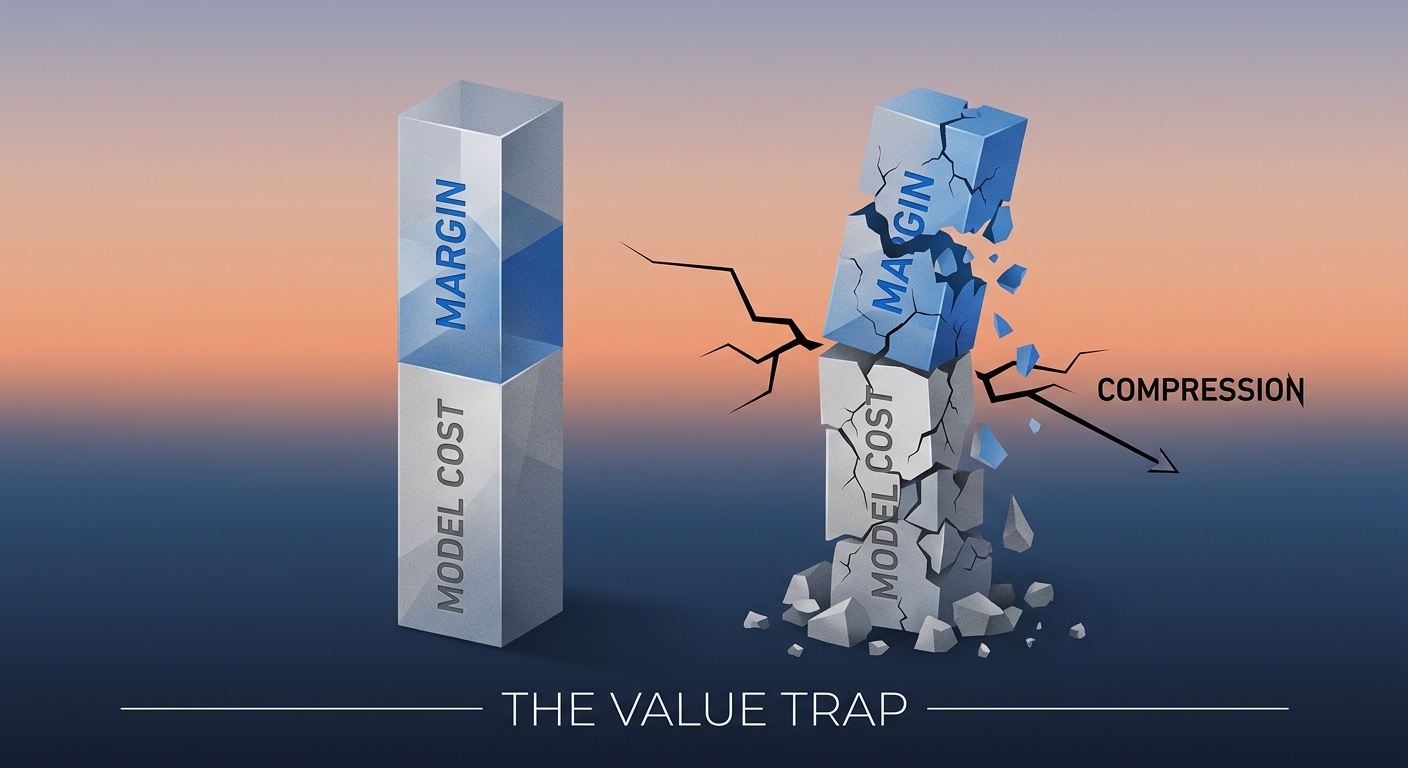
The price of intelligence is in freefall.
Eighteen months ago, processing one million tokens with a frontier model cost around sixty dollars. Today the same capability costs under two dollars. The trajectory is not slowing down. Every lab is racing the others to the floor.
For teams building applications, this looks like good news. Lower infrastructure costs. Better margins. Faster growth possible at lower spend.
For a specific category of company, the ones whose entire value proposition was built on top of the margin between model cost and what customers would pay, it is the opposite of good news.
The collapse of model prices is the most important business story in AI right now. The companies catching up to that fact are the ones that will not exist in twelve months.
The margin that made the business work
A certain generation of AI startups was built on a simple model.
Take a frontier capability. Wrap it in a better interface. Add some workflow automation around it. Charge customers a meaningful premium over the raw model cost. Pocket the margin.
This worked because the raw model was difficult to use directly. The API was complex. The prompting required expertise. The integration work was significant. The wrapper had real value because it abstracted real complexity.
The margin was real because the capability was scarce relative to the expertise required to use it.
Both of those conditions are changing simultaneously.
The models are getting easier to use directly at exactly the same time that they are getting cheaper. Every price cut is accompanied by better documentation, better tooling, better native interfaces. The complexity that justified the wrapper is being engineered away by the same labs cutting the prices.
The margin is being squeezed from both sides.
The companies that felt it first
The first wave of compression hit the simplest wrappers.
AI writing assistants. AI image generators. AI chat interfaces. Anything where the core capability was one API call and the product was primarily a better UI around that call.
These companies built when the raw API was genuinely hard to use and the capability was genuinely novel. They charged fifty dollars a month for something that now costs customers less than a dollar in direct API costs. The customers noticed. The churn followed.
Some of these companies pivoted. They found the features that could not be replicated with a direct API call. The workflow integrations. The team collaboration features. The proprietary data connections. The things that created value independent of the model cost.
The ones that did not pivot are mostly gone.
The second wave, which is arriving now, hits more sophisticated products. Not simple wrappers. Products that involve real engineering, multiple model calls, complex orchestration, significant workflow automation.
These products have more defensible features. They also have more complex cost structures. And the model cost that was once a small fraction of the value they delivered is now approaching negligible, which raises an uncomfortable question.
If the model cost approaches zero, what exactly are customers paying for?
The uncomfortable math
Here is the calculation that a lot of companies are quietly running right now.
Take the total value a customer believes they are getting from the product. Subtract the value that comes directly from the AI capability, which the customer can now approximate themselves for nearly nothing. What remains is the value that comes from everything else.
For some companies, what remains is substantial. The integrations are deep. The workflow automation is genuinely sophisticated. The proprietary data is irreplaceable. The network effects are real. Customers would pay for this product even if the AI capability were free everywhere.
For other companies, what remains is thin. The value was always primarily in delivering the AI capability in a convenient form. The integrations exist but are shallow. The workflow automation is basic. When you subtract the AI, not much is left.
The companies in the first category are fine. Their margin compression is uncomfortable but not existential.
The companies in the second category are facing a different situation. Their revenue is real today. Their business model becomes much harder to justify as the thing they are delivering becomes available for free.
Most companies have not done this calculation honestly.
The customer who learned to do it themselves
There is a parallel story happening on the customer side.
Eighteen months ago, most non-technical teams using AI products were genuinely dependent on those products. They could not interact with model APIs directly. They did not know how to prompt effectively. The SaaS product was the only practical way to access the capability.
That dependency is eroding.
The models now have excellent native interfaces. The prompting knowledge has diffused through the internet. The internal developer who always suspected the expensive SaaS product could be replicated in a weekend has been proven right by the three colleagues who already replicated it.
The enterprise contract is coming up for renewal. The champion inside the company who advocated for the tool is being asked by their CFO why they are paying two hundred thousand dollars a year for something the team could approximate internally for twenty thousand in direct API costs.
That conversation is happening at thousands of companies right now.
The answers that work in that conversation are specific. Here is the proprietary data integration that cannot be replicated. Here is the workflow that saves forty hours a month per person. Here is the compliance feature that an internal build would require months to match.
The answers that do not work are the ones that used to work. We use the best models. We have a great interface. Our team has deep AI expertise.
The customer can now get the models themselves. The interface is increasingly matched by the labs’ native products. The AI expertise is increasingly commoditised.
The labs are not neutral in this
The model providers are not passive participants in this compression.
Every time Anthropic releases a better native interface, every time OpenAI ships a feature that an ecosystem of startups was charging for, every time Google makes it easier to use their models directly, they are making a deliberate choice to compete with the companies built on top of their APIs.
This is not surprising. It is what platform companies do. They allow ecosystem development to prove out use cases, then absorb the most successful use cases into the platform. It happened with app stores. It happened with cloud providers. It is happening with AI.
The companies that understood this dynamic built around it. They chose use cases the labs would not absorb because they were too vertical, too specialised, or required proprietary data the labs could not access. They built the integrations that required genuine industry expertise. They moved up the stack to where platform absorption is less likely.
The companies that did not understand this dynamic built things that the labs were always going to build themselves eventually.
Eventually is arriving on an accelerated schedule.
The price floor that does not exist
Here is the assumption that most pricing models in the AI space are built on.
That model costs will stabilise at some floor. That there is a point below which inference cannot get cheaper. That the compression will slow and the business models built on top of it will stabilise.
This assumption is probably wrong.
The cost of inference tracks the cost of compute. The cost of compute has been falling for fifty years without a meaningful floor. There is no physical law that prevents frontier model inference from eventually costing fractions of a cent per million tokens.
Open source models are pushing the floor down from another direction. Every time an open source model reaches capability parity with a frontier model, it creates downward pressure on the frontier model’s price. The open source model can be run for the cost of electricity.
The teams whose unit economics depend on the model maintaining a price above a certain threshold are building on an assumption that the market is actively working to invalidate.
What survives the compression
The products that survive look different from the products that are currently most threatened.
They are valuable for reasons that do not compress with model prices.
Proprietary data that cannot be replicated. Regulatory compliance that requires specific certifications. Network effects that make the product more valuable as more people use it. Workflow automation so deeply embedded in how a customer operates that switching costs are measured in months rather than days. Industry expertise that makes the product genuinely better for a specific vertical than any general-purpose tool could be.
None of these are AI stories. They are business stories.
The companies that survive the model price collapse will be the ones that figured out they were not actually in the AI business. They were in the data business, or the workflow business, or the compliance business, or the vertical software business.
The AI was the mechanism. The value was always somewhere else.
The compression is exposing which companies knew that and which ones did not.
The ones that did not know it are finding out now.
The price drop that hit their API bill last week was not the good news it looked like.
It was the announcement that the reckoning is closer than anyone thought.