Every Company Became AI-First. Most of Them Have No Idea What That Actually Means.
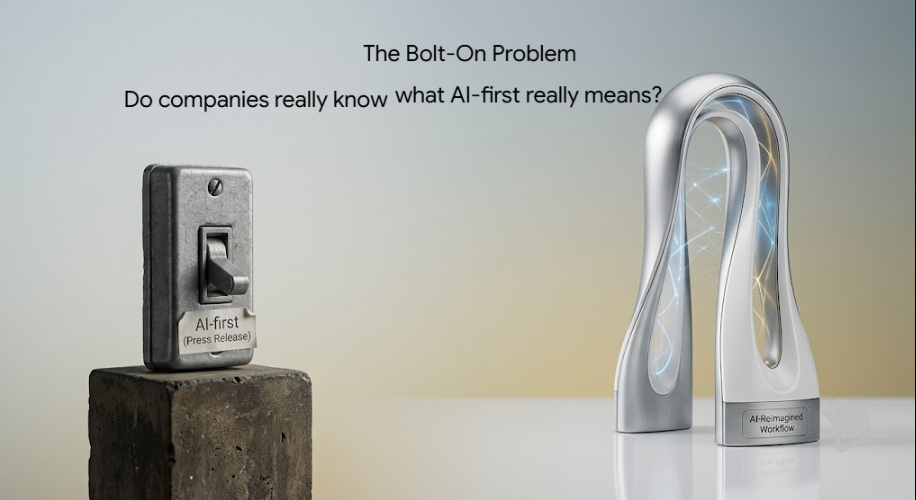 Search any company’s engineering blog from the last eighteen months.
Somewhere in there is a post announcing that the company is now AI-first. The language varies. The substance is identical.
AI is central to everything we build. Our roadmap is being reimagined through the lens of AI. We are embedding intelligence across our entire product surface. We believe AI represents the most significant platform shift in a generation.
Then the post ends. And nothing changes.
The same product ships the same features on the same timeline with a chat button added to the sidebar. The same engineering team builds the same kind of software they were building before. The AI-first announcement was a positioning decision, not a strategic one.
And the companies that made a real strategic decision are quietly building an advantage that the press release companies will not be able to close.
What AI-first actually requires
The companies that are genuinely AI-first share something that is surprisingly hard to see from the outside.
They did not add AI to their existing product. They rebuilt their thinking about what the product should do, starting from the assumption that AI was available, and arrived at different answers than they would have without that assumption.
This is a harder exercise than it sounds. It requires genuine willingness to discard decisions that were correct before AI and are now suboptimal. It requires accepting that some things you spent years building are less valuable than they were. It requires product and engineering leadership that can look at a working system and ask whether it would be built the same way if the team were starting today.
Most leadership teams cannot do this comfortably. The existing system represents past decisions they made and past capital they spent. Reconsidering it feels like criticising themselves.
So the AI-first announcement gets made. The existing roadmap continues. A few AI features get added. The press release was the transformation.
The three things companies think AI-first means
There are three versions of AI-first that companies implement when they make the announcement.
The first is the chat button. There is now a chat interface somewhere in the product. Users can ask questions. The answers come from an LLM. This is the minimum viable AI-first claim. It is also almost entirely decorative. The core product workflow is unchanged. The AI is an optional add-on that most users never touch.
The second is AI-assisted features. The existing workflows now have AI suggestions woven through them. The editor suggests completions. The dashboard summarises data automatically. The support tool drafts responses. This is more substantive than the chat button. It is still additive. The underlying workflow was designed without AI and AI has been inserted into it.
The third is workflow redesign. The company looked at what users are actually trying to accomplish and redesigned the workflow from scratch assuming AI was available. The result does not look like the old product with AI added. It looks like something that would only be possible because AI exists.
Most companies that announce AI-first are in the first or second category. The third category is where the actual competitive advantage lives.
The workflow that only exists because of AI
Here is the clearest test of whether a company has made the genuine strategic shift.
Show the product to someone who has never seen it before and ask them to explain how it works.
If they can understand it entirely by analogy to pre-AI software, AI has been bolted on. The product is recognisably a CRM, or a project manager, or a document editor with some AI features. The AI is visible as AI, separate from the core workflow.
If they struggle to explain it in terms of pre-AI software, the workflow has been genuinely reimagined. The AI is not a feature. It is the mechanism by which the product operates. The user is doing something that was not possible before.
Companies in the second category are rare. They are also the ones growing the fastest in their categories right now.
Not because they have better AI than their competitors. Most of them use the same APIs. The frontier capability is accessible to everyone.
Because they asked a harder question than “where can we add AI?”
They asked “if we assumed AI was available, what would this product look like, and what would the user be able to do that they cannot do today?”
The answer to that question is not the same for every product. For some products, it turns out that AI does not fundamentally change the core workflow. The chat button is the right answer.
For most products, the honest answer is much more disruptive than anyone in the company wants to accept.
The engineering team caught in the middle
The people who feel the AI-first announcement most acutely are the engineers who have to build against it.
They are told the company is AI-first. They are then handed a backlog that looks like the old backlog with some AI tickets added. They are asked to move fast and integrate AI everywhere. They are evaluated on shipping AI features.
What they are not given is a coherent answer to the question of what AI-first actually means for the specific systems they maintain.
Should the data model change to support AI-generated content differently from user-generated content? The announcement did not say.
Should the API be redesigned to support the different latency and cost characteristics of AI operations? The announcement did not say.
Should the observability infrastructure be extended to understand AI behavior in production? The announcement did not say.
The engineers are being asked to implement a strategy that has not been defined below the press release level. The AI features they ship are real. They are not connected to a coherent architectural vision because no coherent architectural vision was developed. The announcement came before the thinking.
The companies that did the thinking first
The genuine AI-first companies are identifiable by a specific pattern in how they talk about their product internally.
They have a clear answer to “what can users do now that they could not do before?” that is not answered by listing AI features. It is answered by describing a new workflow that the AI enables.
They have made explicit decisions about which parts of their existing architecture to keep and which to rebuild. Not “we will add AI to everything” but “this part of the system becomes unnecessary because AI changes how users accomplish this, and this other part becomes more important because AI creates a new bottleneck here.”
They have a different relationship with failure modes. Traditional software fails in deterministic ways. AI software fails in probabilistic ways. The companies that have genuinely integrated AI have built their product and their infrastructure around that difference. The companies that have added AI have not.
The thinking that produces these answers takes months. It requires the kind of honest product conversation that is uncomfortable to have. It produces a roadmap that looks different from the old roadmap in ways that make stakeholders nervous.
Most companies chose the press release instead.
The gap that is widening
Eighteen months ago, the difference between AI-first companies and AI-added companies was a few quarters of roadmap.
That gap is now measured in years.
The companies that rebuilt their product thinking around AI have users who have built new habits and new workflows around what the product enables. Those habits are switching costs. The workflows are integrations. The switching costs are accumulating every month.
The companies that added AI to their existing product have users who use the AI features occasionally and would not notice much if they were removed. There is no new habit. There is no workflow dependency. There is a chat button.
The market will eventually price this difference correctly.
The acquisitions and the shutdowns that are coming in the next eighteen months will follow a pattern that is already visible in the metrics of companies that know where to look.
Revenue per user is diverging between the two categories. The AI-first companies are growing it. The AI-added companies are not.
User engagement with core workflows is diverging. The AI-first companies are increasing it. The AI-added companies are seeing their core workflows used less, replaced not by AI-enabled alternatives but by nothing, because the users are not finding the AI additions valuable enough to change how they work.
The press release said AI-first.
The metrics are saying something different.
And the companies that built genuine AI-first products are watching the gap widen with something that looks very much like patience.
They did the hard work eighteen months ago.
Now they are waiting for the market to notice.
It is starting to notice.