Meta Just Open-Sourced Its Best Model. The AI Industry's Business Model Has 48 Hours to Respond.
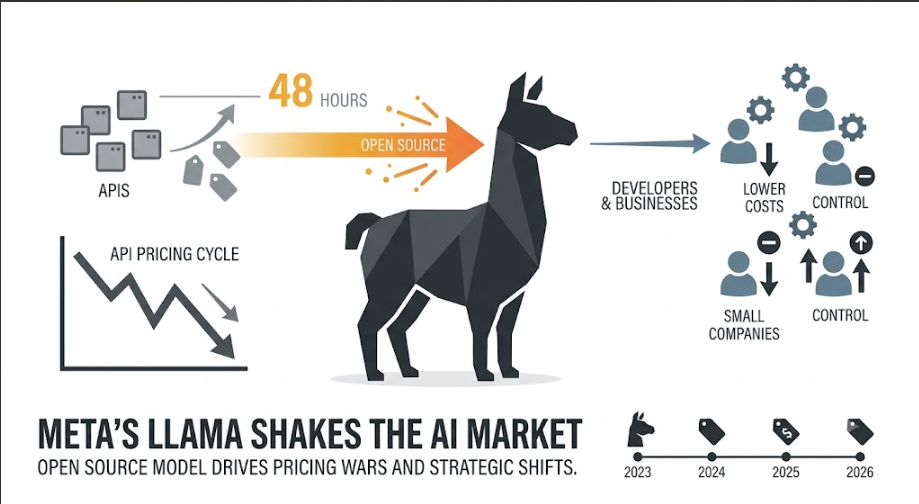 Meta does not need to win the AI race to determine its outcome.
They just need to keep doing what they have been doing for the last two years.
Release a model. Make it free. Make it open. Watch the rest of the industry scramble.
The latest Llama release landed this week. The benchmarks are remarkable. The performance on coding, reasoning, and instruction following is within striking distance of models that cost money to access. The weights are downloadable. You can run it on your own hardware tonight.
By the time most teams finished reading the announcement, the conversations had already started.
Why are we paying for API access again?
What Meta is actually doing
Meta’s open source AI strategy is not altruism.
It is a calculated competitive move that makes complete sense if you understand Meta’s actual business.
Meta makes money from advertising. Better AI makes their advertising products better. They do not need to monetise the model directly. They need the model to be widely adopted so that the ecosystem, the tools, the integrations, the developer familiarity, develops around their architecture.
Every developer who learns to work with Llama is a developer who is not exclusively building their expertise on OpenAI’s or Anthropic’s API. Every company that deploys Llama internally is a company that does not depend on a third-party API for their core AI infrastructure.
Meta wins by commoditising the thing their competitors are trying to sell.
The frontier labs are selling intelligence as a service. Meta is making intelligence a utility.
The difference matters enormously for the companies in the middle.
The pricing cycle nobody talks about
Here is the pattern that has played out three times now.
Meta releases a strong open source model. The model is good enough to handle a meaningful fraction of production use cases. Developers start running it locally and on cheap cloud hardware.
Within weeks, OpenAI and Anthropic reprice.
Not dramatically. Not a panic. A careful, measured reduction in API costs that coincidentally positions their models as still worth paying for relative to the free alternative.
The repricing is real. The costs have fallen significantly across multiple rounds of this cycle. Teams that were paying sixty dollars per million tokens eighteen months ago are paying under two dollars today.
Every repricing is framed as the labs passing on efficiency gains to customers.
Every repricing correlates precisely with a Meta release.
The cycle is not a coincidence. It is competitive pressure being transmitted through pricing in real time.
The companies caught in the middle
There are three types of companies in this environment.
The first type is the infrastructure providers. The ones selling compute, tooling, and the operational layer around models. They are largely indifferent to which model customers run. They make money either way. The open source trend helps them because it drives more customers to self-host, which requires more infrastructure.
The second type is the frontier labs themselves. They are feeling the pressure but they have a real response. Their models are still meaningfully better on the hardest tasks. The capability gap has narrowed. It has not closed. There are problems where paying for a frontier model is still the right answer.
The third type is the product companies sitting between these two. They are charging customers for AI-powered features. Their costs are determined by API pricing or by the compute to run open source models. Their revenue depends on customers believing the AI is worth paying for.
Every Meta release tightens the economics for this third type.
When the model you were accessing via expensive API is now available free, your customer starts asking whether you are adding enough value to justify your margin on top of it.
Sometimes the answer is yes. The workflow integration, the data connections, the product quality are genuinely worth it.
Sometimes the answer is becoming no, and the customer is starting to do that math.
The developers who already moved
The migration away from proprietary APIs toward open source models is not theoretical.
It is visible in the inference infrastructure companies that run open source models as a service. Their revenue has grown dramatically as companies that used to use frontier APIs have shifted a portion of their workload to cheaper alternatives.
It is visible in the self-hosted deployment stories appearing in engineering blogs with increasing frequency. Teams describing how they moved a classification workload off GPT-4 onto a local Llama deployment and their monthly AI costs dropped by eighty percent.
It is visible in the job postings asking for experience with model deployment, inference optimization, and quantization techniques that only matter if you are running models yourself.
The migration is real. It is in the early-to-middle stage.
The teams that have moved are the ones with the technical capacity to manage their own model infrastructure. That capacity is spreading.
What frontier actually means now
Eighteen months ago, frontier was clear.
The best models from OpenAI and Anthropic were dramatically better than anything available for free. The gap was wide enough that most use cases genuinely required it.
Today frontier means something narrower.
The tasks where frontier models outperform strong open source alternatives are real but specific. Complex multi-step reasoning. Subtle instruction following. Tasks requiring extensive world knowledge at the margins. The hardest ten percent of what production AI systems actually do.
The other ninety percent is now contested territory.
Open source models handle it adequately. Often they handle it well. The teams that need to decide between a free model and a paid model for a specific task are increasingly finding that the free model is sufficient.
This is not the story the frontier labs tell publicly. Their benchmarks emphasize the tasks where they win.
The developers running production systems are running their own benchmarks. On their specific tasks. With their specific data. And the conclusions are different from the official benchmarks more often than anyone expected.
The accelerating cycle
Each Llama release has been more capable than the last.
The gap between the best open source model and the best proprietary model has narrowed consistently. Not smoothly. Not linearly. But the direction has been consistent.
The question the industry is genuinely uncertain about is whether the gap closes completely.
The frontier labs believe they can maintain a meaningful capability lead. They have the compute, the data, and the research talent. The lead is real.
Meta believes the gap closes. Or at least narrows enough that the case for paying for access becomes untenable for a large enough fraction of use cases that the frontier labs’ business models require fundamental rethinking.
Both of these beliefs drive behavior.
The frontier labs are racing to build products and ecosystems around their models that create value independent of raw capability. They are becoming platform companies rather than model companies.
Meta is releasing models with increasing capability and increasing openness.
The teams in the middle are watching both moves and making decisions about which direction to lean.
The decision that is worth making explicitly
Every team using AI in production has an implicit answer to the following question.
What would it take for us to move a significant portion of our AI workload to open source models?
For some teams, the answer is already yes for large portions of their stack. The migration is complete or in progress.
For other teams, the answer involves capability gaps that open source cannot yet close. The frontier model is genuinely better for their specific use case in ways that justify the cost.
For a large number of teams, nobody has asked the question explicitly.
The costs are paid every month. The model is the one that was chosen when the product was built. The migration analysis has never been done because there was always something more urgent.
The Meta release this week is a good reason to ask it now.
Not because the answer is always to migrate. Because the answer might be, and not knowing is more expensive than finding out.
The Llama weights are available tonight.
The analysis does not take as long as the migration.
And the migration might not take as long as you think.